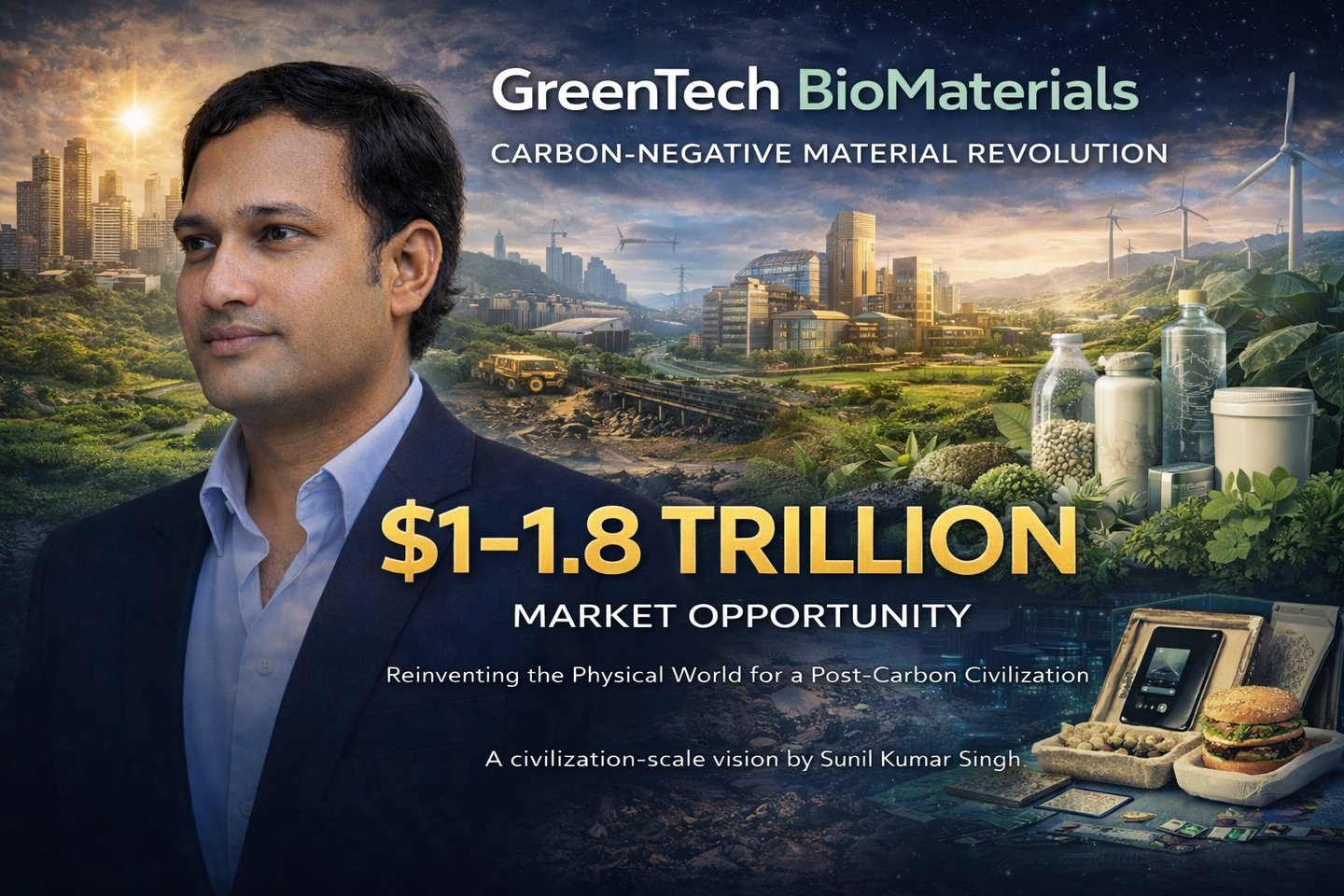
GreenTech BioMaterials
Carbon-Negative Material Revolution
Reinventing the Physical World for a Post-Carbon Civilization
A Civilization-Scale Vision by Sunil Kumar Singh
Abstract
GreenTech BioMaterials is a planet-scale industrial transformation initiative designed to replace fossil-based, carbon-intensive materials with carbon-negative, bio-engineered alternatives.
Modern civilization is built on materials—plastics, cement, steel, and packaging—that silently generate over 50% of global industrial emissions. Energy transition alone cannot solve this. The physical world itself must change.
BioMaterials positions biological manufacturing and bio-derived materials as core industrial infrastructure—enabling plastic alternatives, bio-cement, bio-steel innovation, and sustainable packaging dominance.
With a projected $1–$1.8 trillion market opportunity, BioMaterials redefines how humanity builds, packages, and consumes—without sacrificing performance or scale.
1. The Hidden Carbon Crisis: Materials, Not Energy
Even in a 100% renewable world:
Cement still emits CO₂
Steel still emits CO₂
Plastics still emit CO₂
Packaging waste still accumulates
The Numbers
Cement: ~8% of global emissions
Steel: ~7–9%
Plastics: ~4–5% and rising
Packaging waste: billions of tons annually
Decarbonization fails if materials remain fossil-based.
2. The Core Insight: Biology Is the Ultimate Factory
Nature already solves what industry struggles with:
Self-assembly
Low-temperature manufacturing
Carbon sequestration
Regeneration
Waste-free cycles
BioMaterials’ Strategic Shift:
Move manufacturing from chemistry to biology
This replaces:
High heat
High pressure
High emissions
With:
Fermentation
Enzymatic synthesis
Biomineralization
Microbial manufacturing
3. Plastic Alternatives at Industrial Scale
BioMaterials targets plastics first—where substitution is fastest and impact is massive.
Bio-Plastic Platforms
PHA, PLA, and next-gen biopolymers
Algae- and cellulose-based plastics
Protein- and starch-derived materials
Fully compostable & marine-safe plastics
Advantages
Carbon-negative lifecycle
Performance parity with petroplastics
Drop-in compatibility with existing manufacturing
End-of-life biodegradation
Plastic pollution becomes legacy waste, not future risk.
4. Bio-Cement: Turning Buildings into Carbon Sinks
Concrete is civilization’s backbone—and its carbon liability.
BioMaterials introduces bio-cement and bio-concrete using:
Microbial induced calcite precipitation (MICP)
Carbon-mineralizing bacteria
Low-temperature curing
CO₂-infused binding processes
Outcomes
60–90% emission reduction
Net carbon-negative structures
Self-healing concrete
Longer infrastructure lifespan
Cities transform from emitters into carbon vaults.
5. Bio-Steel & Metallurgical Breakthroughs
Steelmaking requires extreme heat—traditionally from coal.
BioMaterials accelerates:
Biomass-derived reducing agents
Bio-hydrogen integration
Enzyme-assisted ore processing
Low-carbon alloy formation
Steel production shifts from:
Carbon-intensive → carbon-neutral or carbon-negative
This unlocks clean infrastructure at global scale.
6. Sustainable Packaging Dominance
Packaging is the fastest-growing material category.
BioMaterials establishes:
Fully compostable food packaging
Bio-coated paper replacing multilayer plastics
Edible & dissolvable packaging
Smart bio-packaging with shelf-life extension
Market Strategy
Food & beverage
E-commerce
Pharmaceuticals
Consumer goods
Sustainable packaging becomes cheaper and mandated, not premium.
7. Carbon-Negative by Design
BioMaterials integrates carbon removal into manufacturing.
Carbon Logic
Feedstocks grown via photosynthesis
Carbon locked into long-life materials
Waste converted into soil & biomass
Closed-loop recovery systems
Every product becomes:
A unit of stored atmospheric carbon
8. Industrial Scale-Up & Infrastructure
BioMaterials is not lab science.
It is designed for:
Gigafactories for bio-manufacturing
Regional biomass supply networks
AI-controlled fermentation systems
Standardized material certifications
Global licensing & deployment
Scale is engineered from day one.
9. Integration with Circular Economy & Recycling
BioMaterials integrates seamlessly with:
Organic waste streams
Agricultural residues
Forestry byproducts
Municipal bio-waste
Recycling becomes:
Biological
Non-toxic
Energy-light
Waste turns into feedstock, not landfill.
10. Market Potential: $1–$1.8 Trillion
BioMaterials monetizes through:
Material supply contracts
Licensing bio-manufacturing IP
Packaging dominance deals
Infrastructure & construction partnerships
Government green procurement
Demand is structural, policy-driven, and consumer-aligned.
11. Why Sunil Kumar Singh’s Vision Is Industrial, Not Experimental
This initiative reflects a deep strategic pattern:
Replace foundations, not cosmetics
Build factories, not slogans
Align biology with infrastructure
Design for mass adoption
BioMaterials does not ask society to consume less.
It allows society to build better.
12. Strategic Roadmap
Phase I: Platform & IP (2026–2028)
Bio-material R&D platforms
Pilot bio-factories
Certification & standards alignment
Early packaging & construction pilots
Phase II: Industrial Expansion (2028–2035)
Gigafactory-scale bio-manufacturing
Global packaging conversion
Bio-cement infrastructure projects
Steel industry partnerships
Phase III: Material System Replacement (2035–2050)
Petro-material displacement
Carbon-negative cities & supply chains
Circular bio-industrial economy
Global material standard reset
13. Civilizational Impact
Climate
Major industrial emissions eliminated
Long-term carbon storage in materials
Economy
New bio-industrial sectors
Resilient domestic manufacturing
Environment
Reduced pollution & toxicity
Regenerated ecosystems
Conclusion: The Future Is Grown, Not Mined
GreenTech BioMaterials recognizes a fundamental truth:
You cannot build a sustainable civilization with fossil-era materials.
By shifting manufacturing from extraction to biological creation, BioMaterials enables a world where:
Buildings store carbon
Packaging disappears safely
Industry aligns with nature
Under the leadership of Sunil Kumar Singh, BioMaterials stands as:
The material foundation of a carbon-negative civilization.
If you want next, I can:
Merge BioMaterials with RareEarthX, SupplySphere, HydrogenGrid, AdaptNation, AirVault, and FusionCore into a Unified GreenTech Civilization Stack
Draft a Global BioMaterials Industrial Policy
Create a $1–$1.8T investment thesis
Design a bio-manufacturing gigafactory blueprint
Just say the next direction.
The AI Operating System for Human Intelligence & Skills
Why Education, Reskilling, and Human Capital Form a $10–15 Trillion Opportunity — and Why Learning Never Ends
Category: Education, Skills & Human Capital Opportunity Size: $10–15 Trillion Vision: Build a global, AI-powered learning economy that continuously upgrades human intelligence, skills, and employability
🌍 The Real Crisis of the 21st Century Is Not Technology — It Is Obsolescence
Technology is advancing faster than any education system in history.
AI evolves every year. Jobs change every few years. Skills expire faster than degrees.
Yet education systems still assume:
Learn once
Work for decades
Retire
That model is broken.
The future belongs not to the most educated — but to the most adaptable.
This is why GreenTech EduVerse™ exists.
🧠 What Is GreenTech EduVerse™?
GreenTech EduVerse™ is not an online course platform. It is not a university replacement. It is not a learning app.
GreenTech EduVerse™ is a planet-scale AI operating system for learning, skills, and human capital.
It connects:
Personalized AI tutors
Skill passports and credentials
Workforce intelligence
Industry demand forecasting
Government education systems
Into one continuous learning economy.
If enterprises run on ERP systems and nations run on GovOS™, human intelligence now runs on EduVerse™.
📉 Why the Old Education Model Is Failing
Degrees measure the past. Jobs demand the future.
Today:
Graduates are unemployed
Companies can’t find skilled workers
Governments overspend on ineffective training
Individuals don’t know what to learn next
Education is disconnected from:
Industry demand
Technological change
Economic reality
EduVerse™ reconnects them.
⚙️ Core Architecture of GreenTech EduVerse™
1️⃣ Personalized AI Tutors
One teacher per human
EduVerse™ provides:
AI tutors adapted to each learner
Continuous assessment and feedback
Learning paths optimized for goals
Multilingual, 24×7 availability
Education becomes:
Personalized
Affordable
Borderless
No human is left behind.
2️⃣ Skill Passports & Verified Credentials
Skills that travel globally
EduVerse™ introduces:
Digital skill passports
AI-verified competency records
Continuous skill updates
Globally portable credentials
Degrees become static. Skill passports remain alive.
3️⃣ Workforce Intelligence & Job Matching
Learning aligned with demand
EduVerse™ integrates:
Real-time labor market data
Skill demand forecasting
Industry-aligned curriculum updates
AI job matching
People learn what the economy actually needs.
4️⃣ Government & Enterprise Upskilling Systems
Reskilling at national scale
EduVerse™ enables:
National reskilling programs
Corporate workforce transformation
AI-driven training ROI measurement
Policy-aligned education planning
Human capital becomes a managed national asset.
💰 Why $10–15 Trillion Is a Real Opportunity
Education is no longer a one-time expense.
It is a lifetime subscription.
Let’s break it down.
🎓 1. Global Education Systems
Digital schools, universities, lifelong learning platforms.
Market potential: $4–6 Trillion
🏭 2. Corporate Training & Workforce Reskilling
Continuous upskilling across industries.
Market potential: $3–5 Trillion
🌍 3. Government Skill & Employment Programs
National reskilling and employment alignment.
Market potential: $2–4 Trillion
🧠 4. AI Learning Infrastructure & Platforms
Tutors, assessment engines, credential systems.
Market potential: $1–3 Trillion
📊 Total Human Capital Intelligence Market
➡️ $10–15 Trillion+
And unlike most markets:
Reskilling never ends.
🚀 Why GreenTech EduVerse™ Scales Globally
🔥 1. Jobs Will Change Faster Than Schools
AI ensures skills become obsolete every few years.
Continuous learning becomes mandatory.
🔥 2. One-to-One AI Learning Is Infinitely Scalable
AI tutors scale without teacher shortages.
Cost per learner collapses.
🔥 3. Skills Are the New Currency
Employability determines income, dignity, and opportunity.
EduVerse™ becomes the global skills ledger.
🔥 4. Network Effects Across Humanity
More learners → better models → better outcomes.
EduVerse™ improves with every human it serves.
🌐 Who Uses GreenTech EduVerse™?
🎓 Students & Lifelong Learners
🏢 Corporations & Employers
🌍 Governments & Education Ministries
🏦 Workforce Development Institutions
🌐 Global Talent Platforms
This is B2C + B2B + B2G at planetary scale.
🛣️ Strategic Roadmap (2026–2035 Vision)
🟢 Phase 1: 2026–2027 — AI Tutors & Skill Mapping
Personalized AI tutors
Skill passport launch
Pilot government programs
🔵 Phase 2: 2028–2030 — Workforce Intelligence
Job demand forecasting
Enterprise integration
National reskilling systems
🔴 Phase 3: 2030+ — Global Learning Economy
Cross-border skill recognition
AI-driven career orchestration
Human capital intelligence at scale
EduVerse™ becomes the nervous system of global learning.
🌎 Why This Is Bigger Than EdTech
GreenTech EduVerse™ is not about courses.
It is about economic survival in the AI age.
It is:
Bigger than universities
Broader than online learning
Deeper than HR platforms
It is the operating system of human potential.
🔥 Final Reflection
The most valuable infrastructure of the future is not roads or factories.
It is human capability.
Nations that invest in continuous learning will thrive. Those that don’t will decline.
GreenTech EduVerse™ exists because:
In an age of intelligent machines, human intelligence must evolve faster.